
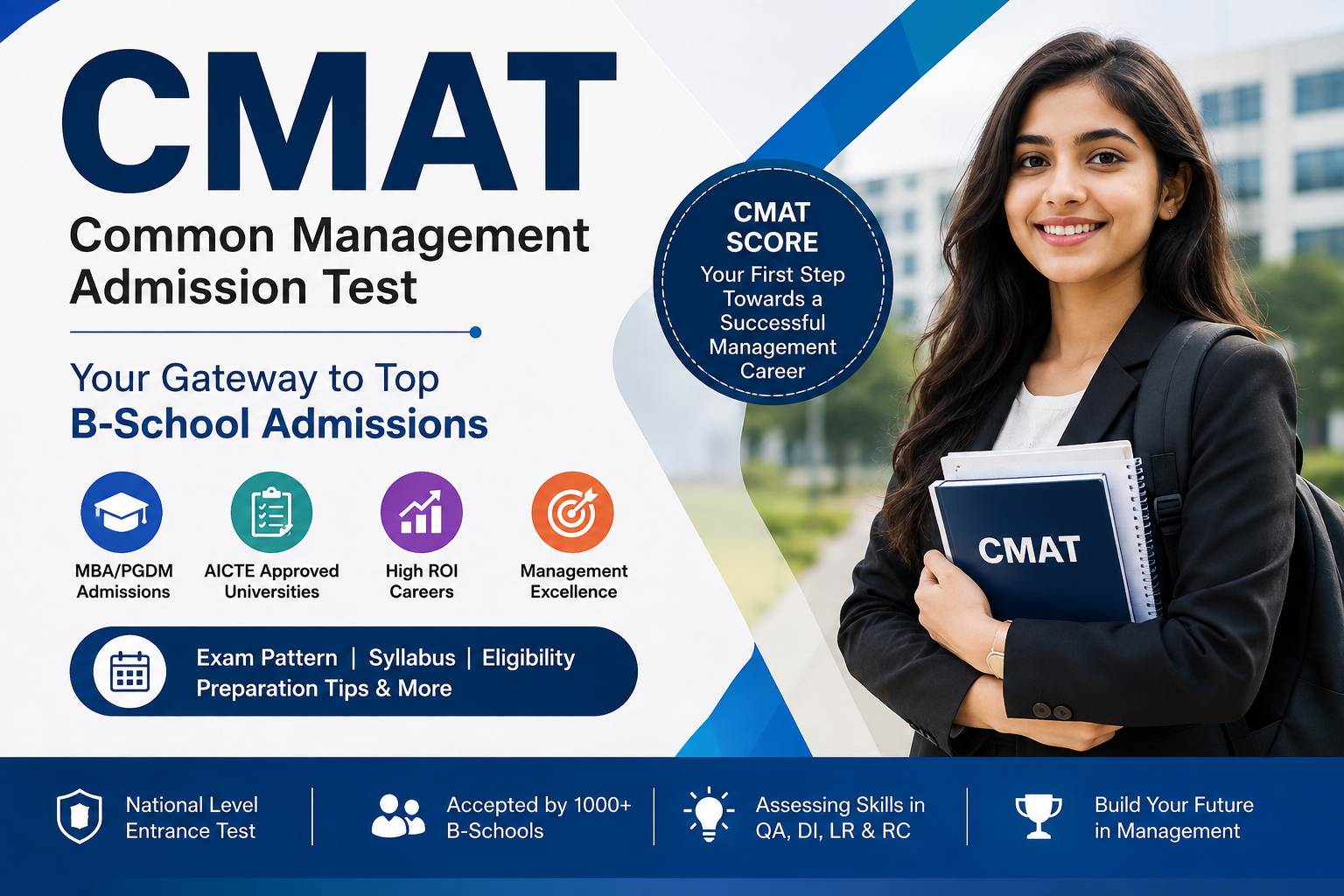
The Common Management Admission Test (CMAT) is a national-level entrance examination conducted for admission to MBA, PGDM, Executive PGDM, and other management programs offered by AICTE-approved institutions and several universities across India. The exam evaluates candidates’ aptitude in quantitative techniques, logical reasoning, language comprehension, general awareness, and innovation & entrepreneurship.
CMAT Highlights:
- Exam Name: Common Management Admission Test (CMAT)
- Exam Level: National
- Exam Mode: Computer-Based Test (CBT)
- Conducting Body: National Testing Agency (NTA)
- Course Offered: MBA, PGDM and Management Programs
- Duration: 3 Hours
- Question Type: Multiple Choice Questions (MCQs)
- Language: English
- Frequency: Once every year
Why Choose CMAT?
- Accepted by 1,000+ MBA colleges.
- Easier compared to several other MBA entrance exams.
- Low application fee.
- No sectional time limit.
- Good opportunity for admission into reputed B-Schools.
- Suitable for fresh graduates and working professionals.
CMAT Eligibility Criteria:
Candidates must satisfy the following requirements:
- Must hold a Bachelor’s Degree in any discipline.
- Final-year undergraduate students are also eligible.
- No minimum age limit.
- No upper age limit.
- Indian nationals can apply.
- Percentage requirements depend on the participating institute.
CMAT Exam Pattern
Section Questions
Quantitative Techniques & Data Interpretation 20
Logical Reasoning 20
Language Comprehension 20
General Awareness 20
Innovation & Entrepreneurship 20
Total Questions 100
Marking Scheme:
- Correct Answer: +4 Marks
- Incorrect Answer: -1 Mark
- Unanswered Questions: No Negative Marking
- Maximum Marks: 400
CMAT Syllabus
1. Quantitative Techniques & Data Interpretation
Topics include:
- Arithmetic
- Algebra
- Geometry
- Mensuration
- Number System
- Probability
- Permutation & Combination
- Time & Work
- Profit & Loss
- Percentages
- Ratio & Proportion
- Data Interpretation
- Pie Charts
- Tables
- Graphs
2. Logical Reasoning
Important topics:
- Blood Relations
- Coding-Decoding
- Seating Arrangement
- Syllogism
- Statement & Assumptions
- Cause & Effect
- Direction Sense
- Critical Reasoning
- Analogies
- Puzzles
3. Language Comprehension
Major topics:
- Reading Comprehension
- Vocabulary
- Grammar
- Sentence Correction
- Para Jumbles
- Synonyms
- Antonyms
- Fill in the Blanks
- Idioms and Phrases
4. General Awareness
Includes questions on:
- Current Affairs
- Indian Economy
- History
- Geography
- Politics
- Business News
- Sports
- Awards
- Science
- International Affairs
5. Innovation & Entrepreneurship
Topics include:
- Startup Ecosystem
- Government Initiatives
- Business Models
- Intellectual Property Rights
- Entrepreneurship Concepts
- Business Environment
- Marketing Basics
- Financial Awareness
CMAT Preparation Tips
Create a Study Plan
- Allocate daily time for each section.
Practice Mock Tests
- Attempt full-length mock tests regularly.
Improve Speed
- Practice solving questions within time limits.
Read Newspapers
- Stay updated with current affairs and business news.
Solve Previous Year Papers
- Understand question patterns and difficulty level.
Revise Regularly
- Prepare short notes and revise them weekly.
Best Books for CMAT Preparation
Quantitative Aptitude
- Quantitative Aptitude by R.S. Aggarwal
- How to Prepare for Quantitative Aptitude by Arun Sharma
Logical Reasoning
- A Modern Approach to Logical Reasoning by R.S. Aggarwal
Verbal Ability
- Word Power Made Easy by Norman Lewis
- High School English Grammar by Wren & Martin
General Awareness
- Manorama Yearbook
- Monthly Current Affairs Magazines
CMAT Selection Process
- CMAT Examination
- Score Card
- College Application
- Shortlisting
- Group Discussion (GD)*
- Personal Interview (PI)
- Final Merit List
- Admission
Documents Required:
- CMAT Admit Card
- CMAT Score Card
- Graduation Mark Sheets
- Degree Certificate
- Class 10 & 12 Certificates
- Government Photo ID
- Passport-size Photographs
- Category Certificate (if applicable)
Career Opportunities After MBA Through CMAT
Graduates can pursue careers such as:
- Marketing Manager
- Financial Analyst
- HR Manager
- Business Consultant
- Operations Manager
- Project Manager
- Sales Manager
- Product Manager
- Data Analyst
- Entrepreneur
Frequently Asked Questions (FAQs)
Is CMAT easier than CAT?
- Generally, CMAT is considered moderately difficult and is often viewed as less challenging than CAT.
How many times is CMAT conducted in a year?
- CMAT is usually conducted once every year.
Is there negative marking?
- Yes. One mark is deducted for every incorrect answer.
Can final-year students apply?
- Yes. Final-year bachelor’s degree students are eligible.
Is CMAT accepted by all MBA colleges?
- No. CMAT is accepted by many AICTE-approved institutions and participating universities, but not all MBA colleges.
CMAT is an excellent opportunity for graduates seeking admission to quality MBA and PGDM programs across India. With a well-planned preparation strategy, consistent practice, and strong conceptual understanding, candidates can achieve a competitive score and secure admission to leading management institutes. Begin your preparation early, practice mock tests regularly, stay updated with current affairs, and focus on time management to maximize your chances of success.
MBA Degree in One Year
Looking for an MBA Degree in One Year? Fast-track programs are designed for eligible working professionals and candidates seeking career advancement. Enhance your management, leadership, and business skills while balancing your professional commitments. Check eligibility, university guidelines, and admission requirements to find the right program for your career goals.