Posted on Leave a comment

Top LLB & BALLB Colleges and Universities in Punjab

Punjab is home to some of India’s leading law colleges and universities offering LLB, BA LLB, BBA LLB, and LLM programs designed to prepare students for successful legal careers. The state features prestigious government institutions, private universities, and autonomous law schools known for quality education, experienced faculty, moot court training, legal aid clinics, internships, and placement opportunities. Students can pursue specialization in areas such as Constitutional Law, Criminal Law, Corporate Law, Intellectual Property Rights, and International Law. With Bar Council of India (BCI)-approved programs, modern infrastructure, research facilities, and industry collaborations, Punjab provides an excellent environment for aspiring lawyers and legal professionals. Graduates from these institutions are well-equipped for careers in litigation, judiciary, corporate legal practice, academia, civil services, and legal consultancy. Discover the top LLB, BA LLB, and LLM colleges and universities in Punjab. Compare admissions, eligibility, fees, placements, and the best law institutes for legal education in Punjab.

1. Rajiv Gandhi National University of Law (RGNUL), Patiala

  • Location: Patiala
  • Established: 2006
  • Courses: BA LLB (Hons.), LLM, Ph.D.
  • Entrance: CLAT (UG & PG)
  • Highlights: National Law University, premier legal education, excellent placements, moot court competitions, strong research culture.

2. Army Institute of Law (AIL), Mohali

  • Location: Mohali
  • Established: 1999
  • Courses: BA LLB, LLM
  • Entrance: AIL LET/CLAT (as per admission category)
  • Highlights: One of India’s top private law colleges, excellent placement record, BCI approved.

3. Lovely Professional University (LPU)

  • Location: Phagwara (Jalandhar)
  • Established: 2005
  • Courses: BA LLB, BBA LLB, LLB, LLM
  • Entrance: LPUNEST/CLAT or Merit
  • Highlights: NAAC A++, NIRF-ranked, international collaborations, corporate internships.

4. Guru Nanak Dev University – Department of Laws

  • Location: Amritsar
  • Established: 1972
  • Courses: LLB, LLM, Ph.D.
  • Entrance: University Entrance Test
  • Highlights: Government university, experienced faculty, research-oriented legal education.

5. Panjab University – University Institute of Legal Studies (UILS)

  • Location: Chandigarh
  • Established: 2004
  • Courses: BA LLB (Hons.), B.Com LLB (Hons.), LLB, LLM
  • Entrance: PU BA LLB Entrance, PU LLB Entrance, PU CET (PG)
  • Highlights: One of India’s leading law schools, judiciary and litigation preparation.

6. Central University of Punjab – School of Legal Studies

  • Location: Bathinda
  • Established: 2024
  • Courses: BA LLB (Hons.), LLM, Ph.D.
  • Entrance: CUET UG/CUET PG
  • Highlights: Central University, interdisciplinary legal education, research focus.

7. Punjabi University – Department of Law

  • Location: Patiala
  • Established: 1962
  • Courses: LLB, LLM
  • Entrance: Punjabi University Entrance Test/Merit
  • Highlights: Renowned state university, quality legal education, experienced faculty.

8. Chandigarh University – University Institute of Legal Studies

  • Location: Mohali
  • Established: 2012
  • Courses: BA LLB, BBA LLB, LLB, LLM
  • Entrance: CUCET/CLAT or Merit
  • Highlights: Industry-oriented curriculum, international exposure, moot courts

9. Rayat Bahra University – School of Law

  • Location: Mohali
  • Established: 2014
  • Courses: BA LLB, BBA LLB, LLB, LLM
  • Entrance: University Entrance/Merit
  • Highlights: Legal aid clinics, internships, practical legal training.

10. CT University – School of Law

  • Location: Ludhiana
  • Established: 2018
  • Courses: BA LLB, B.Com LLB, LLB
  • Entrance: Merit/University Admission Process
  • Highlights: Modern infrastructure, internship opportunities, practical legal education.

11. Desh Bhagat University – University School of Law

  • Location: Mandi Gobindgarh, Fatehgarh Sahib
  • Established: 2013
  • Courses: BA LLB, LLB, LLM, Ph.D.
  • Entrance: DBU Entrance Test / Merit
  • Highlights: BCI-approved law programmes, moot court facilities, legal aid activities, industry-oriented curriculum.

12. Guru Kashi University – Faculty of Law

  • Location: Talwandi Sabo, Bathinda
  • Established: 2011
  • Courses: BA LLB, LLB, LLM
  • Entrance: Merit / University Admission Process
  • Highlights: Practical legal education, experienced faculty, seminars, internships, BCI-approved programmes.

13. Sant Baba Bhag Singh University – School of Law

  • Location: Khiala, Jalandhar
  • Established: 2015
  • Courses: BA LLB, LLB
  • Entrance: Merit-Based Admission
  • Highlights: Modern campus, legal research activities, moot court training, personality development programmes.

14. DAV University – School of Law

  • Location: Jalandhar
  • Established: 2013
  • Courses: BA LLB, BBA LLB, LLB
  • Entrance: Merit / University Admission
  • Highlights: Industry-focused curriculum, experienced faculty, legal awareness camps and internships.

15. Guru Nanak Dev University Regional Campus – Department of Law

  • Location: Jalandhar
  • Established: 1979
  • Courses: LLB
  • Entrance: GNDU Entrance Test
  • Highlights: Regional campus of GNDU, affordable legal education, qualified faculty.

16. Chandigarh Group of Colleges (CGC), Jhanjeri – School of Legal Studies

  • Location: Mohali
  • Established: 2012
  • Courses: BA LLB, BBA LLB
  • Entrance: CGC Admission Process / Merit
  • Highlights: Industry exposure, moot court competitions, internships, skill-based legal education.

17. Amity University Punjab – School of Law

  • Location: Mohali
  • Established: 2021
  • Courses: BA LLB (Hons.), BBA LLB (Hons.), LLM
  • Entrance: Amity Admission Process / CLAT Score Accepted
  • Highlights: International curriculum, research-driven learning, global collaborations, modern infrastructure.

18. Adesh University – Faculty of Law

  • Location: Bathinda
  • Established: 2012
  • Courses: LLB
  • Entrance: Merit-Based Admission
  • Highlights: Professional legal education, experienced faculty, practical legal training.

19. Sri Sai University – School of Law

  • Location: Pathankot
  • Established: 2011
  • Courses: BA LLB, LLB
  • Entrance: Merit / University Admission
  • Highlights: Affordable fee structure, practical legal education, internships and moot court activities.

20. Aryans College of Law

  • Location: Rajpura, Patiala
  • Established: 2007
  • Courses: BA LLB, LLB
  • Entrance: Merit / Centralized Counselling
  • Highlights: BCI-approved programmes, legal aid clinics, seminars, internship opportunities, career-oriented legal education. Punjab follows centralized counselling for many law admissions across participating institutions.

21. Rayat College of Law

  • Location: Railmajra, SBS Nagar (Nawanshahr)
  • Established: 2004
  • Courses: BA LLB, LLB
  • Entrance: Merit-Based Admission
  • Highlights: BCI-approved institution, moot court activities, legal aid camps, experienced faculty.

22. G.H.G. Institute of Law

  • Location: Sidhwan Khurd, Ludhiana
  • Established: 2006
  • Courses: BA LLB, LLB
  • Entrance: Merit-Based Admission
  • Highlights: Quality legal education, practical legal training, seminars and workshops, affiliated with Panjab University.

23. Baba Farid Law College

  • Location: Bathinda
  • Established: 2004
  • Courses: BA LLB, LLB
  • Entrance: Merit-Based Admission
  • Highlights: Well-known law college in the Malwa region, experienced faculty, legal awareness programmes.

24. Global Group of Institutes – School of Law

  • Location: Amritsar
  • Established: 2002
  • Courses: BA LLB, LLB
  • Entrance: Merit / University Admission Process
  • Highlights: Modern campus, internship opportunities, practical legal education, personality development programmes.

25. RIMT University – School of Legal Studies

  • Location: Mandi Gobindgarh
  • Established: 2015
  • Courses: BA LLB, BBA LLB, LLB
  • Entrance: RIMT Entrance Test / Merit
  • Highlights: Industry-oriented curriculum, moot court training, legal research, experienced faculty.

26. Khalsa College of Law

  • Location: Amritsar
  • Established: 1968
  • Courses: LLB
  • Entrance: Merit-Based Admission
  • Highlights: One of the oldest law colleges in Punjab, reputed faculty, emphasis on ethics and advocacy skills.

27. Doaba College – Department of Law

  • Location: Jalandhar
  • Established: 1950
  • Courses: LLB
  • Entrance: Merit-Based Admission
  • Highlights: Historic educational institution, affordable legal education, experienced teaching staff.

28. Lyallpur Khalsa College – Department of Law

  • Location: Jalandhar
  • Established: 1908
  • Courses: LLB
  • Entrance: Merit-Based Admission
  • Highlights: Heritage institution, strong academic reputation, extracurricular and legal awareness programmes.

29. Guru Gobind Singh College for Women – Department of Law

  • Location: Chandigarh
  • Established: 1973
  • Courses: LLB
  • Entrance: Panjab University Admission Process
  • Highlights: Women’s higher education, quality legal studies, experienced faculty, affordable fee structure.

30. Sukhjinder Group of Institutes – College of Law

  • Location: Gurdaspur
  • Established: 2012
  • Courses: BA LLB, LLB
  • Entrance: Merit-Based Admission
  • Highlights: Career-oriented legal education, practical courtroom exposure, seminars, internships, and legal aid activities.

31. S.S. Memorial College of Law

  • Location: Dinanagar, Gurdaspur
  • Established: 2006
  • Courses: BA LLB, LLB
  • Entrance: Merit-Based Admission
  • Highlights: BCI-approved programmes, moot court training, legal aid camps, experienced faculty.

32. St. Soldier Law College

  • Location: Jalandhar
  • Established: 2004
  • Courses: BA LLB, LLB
  • Entrance: Merit / University Admission Process
  • Highlights: Professional legal education, internships, seminars, courtroom exposure, modern infrastructure.

33. Swami Vivekanand Institute of Engineering & Technology – Department of Law

  • Location: Banur, Mohali
  • Established: 2004
  • Courses: BA LLB, LLB
  • Entrance: Merit-Based Admission
  • Highlights: Practical legal education, experienced faculty, personality development, industry interaction.

34. Universal Group of Institutions – School of Law

  • Location: Lalru, Mohali
  • Established: 2009
  • Courses: BA LLB, LLB
  • Entrance: Merit / University Admission
  • Highlights: Moot court activities, internships, legal workshops, career-oriented curriculum.

35. Chandigarh Group of Colleges (CGC), Landran – Department of Law

  • Location: Landran, Mohali
  • Established: 2001
  • Courses: BA LLB, BBA LLB
  • Entrance: Merit-Based Admission
  • Highlights: Modern campus, industry interaction, legal research, internship opportunities.

36. Gulzar Group of Institutes – School of Law

  • Location: Khanna, Ludhiana
  • Established: 2009
  • Courses: BA LLB, LLB
  • Entrance: Merit / University Admission
  • Highlights: Practical legal training, legal awareness programmes, experienced faculty.

37. Vidya Jyoti Educational Society – Law College

  • Location: Dera Bassi, SAS Nagar (Mohali)
  • Established: 2003
  • Courses: LLB
  • Entrance: Merit-Based Admission
  • Highlights: Affordable legal education, qualified faculty, focus on professional ethics and advocacy.

38. Saraswati Group of Colleges – Department of Law

  • Location: Dhanota, Mohali
  • Established: 2004
  • Courses: LLB
  • Entrance: Merit-Based Admission
  • Highlights: Student-focused learning, legal seminars, practical courtroom exposure, experienced faculty.

39. Quest Group of Institutions – School of Law

  • Location: Jhanjeri, Mohali
  • Established: 2009
  • Courses: BA LLB, LLB
  • Entrance: Merit / University Admission
  • Highlights: Internship opportunities, legal research, moot court competitions, industry-oriented curriculum.

40. Amritsar Group of Colleges – School of Law

  • Location: Amritsar
  • Established: 2002
  • Courses: BA LLB, LLB
  • Entrance: Merit-Based Admission
  • Highlights: Practical legal education, modern infrastructure, experienced faculty, legal aid and skill development programmes.

41. Shaheed Udham Singh Group of Institutions – College of Law

  • Location: Tangori, Mohali
  • Established: 1997
  • Courses: BA LLB, LLB
  • Entrance: Merit-Based Admission
  • Highlights: BCI-approved law programmes, experienced faculty, moot court competitions, internships and legal aid activities.

42. Punjab College of Law

  • Location: Raipur, Patiala
  • Established: 2007
  • Courses: LLB, BA LLB
  • Entrance: Merit / Centralized Counselling
  • Highlights: Affiliated with Punjabi University, BCI-approved programmes, modern classrooms and practical legal education.

43. Sardar Patel College of Law

  • Location: Mansa
  • Established: 2006
  • Courses: LLB
  • Entrance: Merit-Based Admission
  • Highlights: Quality legal education, affordable fee structure, experienced faculty and student-focused learning.

44. Lord Krishna College of Law

  • Location: Kapurthala
  • Established: 2008
  • Courses: LLB
  • Entrance: Merit-Based Admission
  • Highlights: BCI-approved law programme, legal awareness camps, seminars and practical training.

45. National College of Law

  • Location: Sri Muktsar Sahib
  • Established: 2005
  • Courses: LLB
  • Entrance: Merit-Based Admission
  • Highlights: Focus on advocacy skills, legal research, internships and affordable legal education.

46. SGGS Khalsa College – Department of Law

  • Location: Mahilpur, Hoshiarpur
  • Established: 1946
  • Courses: LLB
  • Entrance: Merit-Based Admission
  • Highlights: Heritage institution, experienced faculty, academic excellence and extracurricular legal activities.

47. Guru Ram Das Institute of Legal Studies

  • Location: Amritsar
  • Established: 2003
  • Courses: LLB, BA LLB
  • Entrance: Merit / University Admission
  • Highlights: Practical legal education, moot court facilities, legal aid clinics and professional development programmes.

48. Patel Memorial National College – Department of Law

  • Location: Rajpura, Patiala
  • Established: 1966
  • Courses: LLB
  • Entrance: Merit-Based Admission
  • Highlights: Well-established institution, experienced faculty, affordable legal education and strong academic environment.

49. Mata Gujri College – Department of Law

  • Location: Fatehgarh Sahib
  • Established: 1962
  • Courses: LLB
  • Entrance: Merit / Centralized Counselling
  • Highlights: Autonomous college, NAAC-accredited institution, quality legal education and modern academic facilities

50. Punjab School of Law, Punjabi University

  • Location: Patiala
  • Established: 2007
  • Courses: BA LLB (5-Year Integrated)
  • Entrance: Punjabi University Admission Process / Centralized Counselling
  • Highlights: Constituent law school of Punjabi University, BCI-approved programme, moot courts, legal research, internships and strong academic reputation.

LLB & BA LLB Degree in One Year in Punjab:

If you are looking to complete an LLB or BA LLB degree in one year in Punjab, it is important to understand the current regulations. The Bar Council of India (BCI) does not recognize one-year LLB or BA LLB programmes for eligibility to practice law. A standard LLB is a 3-year programme after graduation, while BA LLB is a 5-year integrated programme after Class 12. These programmes must be completed through approved regular law colleges and universities in accordance with BCI and UGC regulations.

Students who have discontinued their education or have academic gaps may explore credit transfer, lateral entry (where applicable), or seek guidance from recognized universities regarding permissible academic pathways. However, institutions claiming to award a fresh LLB or BA LLB in one year should be approached with caution, as such qualifications may not be valid for enrolment as an advocate or for higher legal studies. Always verify that the university is recognized by the UGC and that the law programme is approved by the Bar Council of India before taking admission.


Posted on Leave a comment

Top LLB & BALLB Universities and Colleges in Kerala

Kerala is one of India’s leading destinations for legal education, offering a wide range of LLB and BA LLB programmes through prestigious universities, government law colleges, national law universities, and private institutions. Students can choose from 3-year LLB programmes after graduation and 5-year integrated BA LLB courses after Class 12. Admissions are primarily based on entrance examinations such as KLEE (Kerala Law Entrance Examination) and CLAT, depending on the institution. Kerala’s law colleges emphasize academic excellence, moot court training, legal aid clinics, internships, research, and practical courtroom exposure. Graduates have excellent career opportunities in litigation, judiciary, corporate law, legal consultancy, civil services, academia, and public administration, making Kerala an ideal destination for aspiring legal professionals.  Explore the top LLB and BA LLB universities and colleges in Kerala with details on courses, eligibility, entrance exams, fees, and career opportunities.

Law Colleges in Kerala:

1. National University of Advanced Legal Studies (NUALS), Kochi

  • Location: Kochi
  • Established: 2005
  • Courses: BA LLB (Hons), LLM, PhD
  • Entrance: CLAT
  • Highlights: National Law University, excellent placements, moot courts, research-oriented.

2. School of Legal Studies, CUSAT, Kochi

  • Location: Kochi
  • Established: 1962
  • Courses: LLB, LLM, Integrated Law Programmes
  • Entrance: CUSAT CAT
  • Highlights: Premier university law department with strong academic reputation.

3. Government Law College, Thiruvananthapuram

  • Location: Thiruvananthapuram
  • Established: 1875
  • Courses: BA LLB, LLB, LLM
  • Entrance: KLEE
  • Highlights: One of India’s oldest law colleges with distinguished alumni.

4. Government Law College, Ernakulam

  • Location: Kochi
  • Established: 1874
  • Courses: B.Com LLB, LLB, LLM
  • Entrance: KLEE
  • Highlights: Historic government institution with affordable fees.

5. Government Law College, Thrissur

  • Location: Thrissur
  • Established: 1970
  • Courses: BBA LLB, LLB, LLM
  • Entrance: KLEE
  • Highlights: Strong academic environment and legal aid activities.

6. Government Law College, Kozhikode

  • Location: Kozhikode
  • Established: 1970
  • Courses: BBA LLB, LLB, LLM
  • Entrance: KLEE
  • Highlights: Popular government law college in North Kerala.

7. Kerala Law Academy Law College

  • Location: Thiruvananthapuram
  • Established: 1966
  • Courses: BA LLB, B.Com LLB, LLM
  • Entrance: KLEE
  • Highlights: Renowned private law institution.

8. Bharata Mata School of Legal Studies

  • Location: Aluva, Ernakulam
  • Established: 2003
  • Courses: LLB, BA LLB
  • Entrance: KLEE
  • Highlights: Industry-oriented legal education.

9. CSI Institute of Legal Studies

  • Location: Thiruvananthapuram
  • Established: 2002
  • Courses: BA LLB, LLB
  • Entrance: KLEE
  • Highlights: Well-established private institution.

10. CSI College of Legal Studies

  • Location: Kottayam
  • Established: 2002
  • Courses: LLB
  • Entrance: KLEE
  • Highlights: Practical legal training.

11. Al Azhar Law College

  • Location: Thodupuzha, Idukki
  • Established: 2014
  • Courses: LLB, BA LLB
  • Entrance: KLEE
  • Highlights: Modern campus with moot court facilities.

12. Al Ameen Law College

  • Location: Shornur, Palakkad
  • Established: 2014
  • Courses: LLB, BBA LLB
  • Entrance: KLEE
  • Highlights: BCI-approved professional law programmes.

13. Sree Narayana Law College

  • Location: Ernakulam
  • Established: 2012
  • Courses: LLB
  • Entrance: KLEE
  • Highlights: Focus on legal ethics and advocacy.

14. Sree Narayana Guru College of Legal Studies

  • Location: Kollam
  • Established: 2013
  • Courses: BA LLB, BBA LLB, B.Com LLB, LLB
  • Entrance: KLEE
  • Highlights: Multiple integrated law programmes.

15. Markaz Law College

  • Location: Kozhikode
  • Established: 2014
  • Courses: LLB
  • Entrance: KLEE
  • Highlights: Modern infrastructure.

16. Bhavans N.A. Palkhivala Academy of Advanced Legal Studies & Research

  • Location: Kozhikode
  • Established: 2012
  • Courses: BBA LLB (Hons)
  • Entrance: KLEE
  • Highlights: Strong corporate law orientation.

17. V.R. Krishnan Ezhuthachan Law College

  • Location: Palakkad
  • Established: 2014
  • Courses: BBA LLB (Hons)
  • Entrance: KLEE
  • Highlights: Professional legal education.

18. Mar Ivanios College of Law

  • Location: Chengannur
  • Established: 2015
  • Courses: BA LLB, B.Com LLB
  • Entrance: KLEE
  • Highlights: Value-based legal education.

19. Divine Law College

  • Location: Pathanamthitta
  • Established: 2015
  • Courses: BA LLB, B.Com LLB, LLB
  • Entrance: KLEE
  • Highlights: Practical advocacy training.

20. St. Dominic’s College of Law

  • Location: Kanjirappally, Kottayam
  • Established: 2014
  • Courses: BA LLB (Hons), BBA LLB (Hons), LLB
  • Entrance: KLEE
  • Highlights: Moot courts and internship support.

21. IMT Law College

  • Location: Perinthalmanna
  • Established: 2013
  • Courses: BBA LLB, B.Com LLB, LLB
  • Entrance: KLEE
  • Highlights: Career-oriented curriculum.

22. MCT College of Legal Studies

  • Location: Malappuram
  • Established: 2013
  • Courses: LLB
  • Entrance: KLEE
  • Highlights: Affordable private law education.

23. KMCT Law College

  • Location: Malappuram
  • Established: 2013
  • Courses: LLB
  • Entrance: KLEE
  • Highlights: Modern campus.

24. KMM Law College

  • Location: Thrikkakara, Ernakulam
  • Established: 2013
  • Courses: LLB
  • Entrance: KLEE
  • Highlights: Skill-based legal education.

25. Ilahia Law College

  • Location: Muvattupuzha
  • Established: 2014
  • Courses: LLB
  • Entrance: KLEE
  • Highlights: Practical legal exposure.

26. Indira Gandhi Law College

  • Location: Kothamangalam
  • Established: 2014
  • Courses: LLB
  • Entrance: KLEE
  • Highlights: Moot court and legal aid programmes.

27. Co-operative School of Law

  • Location: Thodupuzha
  • Established: 2015
  • Courses: LLB
  • Entrance: KLEE
  • Highlights: Affordable legal education.

28. Mount Zion Law College

  • Location: Pathanamthitta
  • Established: 2014
  • Courses: LLB
  • Entrance: KLEE
  • Highlights: Student-focused legal training.

29. Nehru Academy of Law

  • Location: Lakkidi, Palakkad
  • Established: 2015
  • Courses: LLB
  • Entrance: KLEE
  • Highlights: Practical legal skills development.

30. Silver Jubilee Law College

  • Location: Kattakkada, Thiruvananthapuram
  • Established: 2013
  • Courses: BA LLB
  • Entrance: KLEE
  • Highlights: Integrated law programme with modern facilities.

Also read: University and Colleges in Thrissur, Kerala |

LLB & BA LLB Degree in One Year in Kerala

If you are looking to pursue an LLB or BA LLB in Kerala after a gap year or discontinued studies, you can still apply for admission to recognized law colleges, provided you meet the eligibility criteria prescribed by the university and the Bar Council of India (BCI). Always choose a BCI-approved law college and complete the full duration of the programme to obtain a valid law degree and become eligible for enrolment as an advocate.

Posted on Leave a comment

Why Are Most of The Indian Students Not Interested in Higher Studies in Canada Now?

Indian students are currently showing less interest in pursuing higher studies in Canada due to recent policy changes by the Canadian government, including stricter visa regulations, increased financial requirements, extended processing times, and a cap on international student intake. These challenges have been further compounded by the strained diplomatic relationship between the two countries, making Canada a less attractive option for Indian students. Here are 10 reasons why many Indian students are showing reduced interest in pursuing higher studies in Canada:

1. Diplomatic Tensions:
Ongoing political disputes between India and Canada have led to uncertainties regarding visa processing and diplomatic support.

2. Stricter Study Permit Caps:
Canada has introduced limitations on the number of study permits issued to manage infrastructure pressures like housing shortages.

3. Increased Financial Requirements:
The required proof of financial support for living expenses has nearly doubled, making it challenging for middle-class students to meet eligibility criteria.

4. Housing Crisis:
Rising rents and housing shortages in major cities like Toronto and Vancouver have made living in Canada unaffordable for many students.

5. Reduced Post-Graduation Work Opportunities:
Work permit regulations have tightened, decreasing the chances of gaining relevant Canadian work experience after graduation.

6. Permanent Residency (PR) Challenges:
The Express Entry system has become more competitive, reducing the chances of international students gaining permanent residency.

7. Rising Xenophobia:
Increased anti-immigrant sentiment and hate crimes in Canada have created a hostile environment for visible minorities, including Indian students.

8. High Tuition Costs:
Tuition fees for international students remain significantly higher than for domestic students, burdening Indian families financially.

9. Better Opportunities Elsewhere:
Countries like the UK, Australia, Germany, and the US now offer more favorable visa, work, and settlement policies, attracting Indian students.

10. Uncertainty Over Diplomatic Support:
Due to strained relations, Indian students fear a lack of support from their consulates in case of emergencies or legal issues during their stay.

These factors collectively make Canada a less appealing destination for Indian students than it once was.

Posted on Leave a comment

B.Ed Special Education Course, Admission, Eligibility, Syllabus

B.Ed Special Education is a professional undergraduate degree designed to prepare teachers to educate children with special needs, including those with physical, emotional, mental, or learning disabilities. This program equips aspiring educators with the skills, knowledge, and strategies necessary to effectively teach and support students with diverse abilities in inclusive or specialized classroom settings.

Key Highlights
1. Duration:

  • Typically a 2-year program, but some universities offer integrated or part-time options for working professionals.

2. Eligibility:

A bachelor’s degree (BA, B.Sc, B.Com, or equivalent) with a minimum of 50% marks (may vary by institution).
Entrance exams may be required in some institutions.

3. Specializations:

  • Visual Impairment
  • Hearing Impairment
  • Intellectual Disabilities
  • Learning Disabilities
  • Autism Spectrum Disorders
  • Physical Disabilities
  • Multiple Disabilities

4. Approvals:

Recognized by Rehabilitation Council of India (RCI), National Council for Teacher Education (NCTE), and other relevant bodies.

5. Modes of Study:

  • Regular
  • Distance education
    Online/blended learning (depending on the institution)

6. Curriculum

The curriculum typically includes:

Core Subjects:

  • Philosophical and Sociological Foundations of Special Education
  • Psychology of Development and Learning
  • Teaching Strategies for Special Needs
  • Inclusive Education Policies and Practices

Specialization Subjects:

  • Depending on the chosen area, courses focus on specific disabilities.

Practical Training:

  • Practice teaching in special and inclusive schools.
  • Internships and fieldwork with organizations supporting special education.

Electives:

  • Communication Skills
  • Assistive Technology in Education
  • Curriculum Development for Special Needs

Skills Developed

  • Understanding of diverse learning needs
  • Classroom management strategies
  • Knowledge of assistive technologies
  • Empathy and communication skills
  • Ability to design Individualized Education Plans (IEPs)

Career Opportunities

After completing a B.Ed in Special Education, graduates can work as:

*Special Educators:
In schools (government, private, or special needs institutions)
*Counselors or Therapists:
Supporting emotional and psychological needs
*Curriculum Developers:
Creating materials tailored to special education
*Researchers or Policy Makers:
Contributing to advancements in special education
*Consultants or Trainers:
For NGOs, training centers, or rehabilitation organizations

Salary and Scope

Starting salaries: ₹3–6 LPA (in India); higher internationally.
Growing demand for special educators due to increased awareness and inclusive education policies.

Would you like specific details about institutions, career guidance, or the application process?

B.Ed Special Education Degree in One Year

Looking to advance your career in special education? Explore B.Ed Special Education Degree in One Year pathways designed for eligible candidates under applicable academic regulations. Receive expert admission guidance, flexible learning support where available, and enhance your qualifications to build a rewarding career teaching and supporting children with special needs.

Posted on Leave a comment

How to Get PR in New Zealand: Eligibility, Application & Documents Required

Here’s a detailed guide on obtaining Permanent Residency (PR) in New Zealand, including eligibility criteria, application process, required documents, and why RKIMT is a great choice for assistance:

How to Get PR in New Zealand

New Zealand offers several pathways to PR based on skills, work experience, investment, or family ties. Here’s an overview of the process:

1. Eligibility Criteria for New Zealand PR

To qualify for PR, you must meet one of the following pathways:

a. Skilled Migrant Category (SMC)

  • Age: Below 55 years.
  • Points-based system: Points are awarded for age, work experience, qualifications, and skilled job offers.
  • Language proficiency: IELTS, PTE, or equivalent English test.
  • Health and character: Must pass a medical exam and provide police clearance.

b. Work to Residence

  • Work for an accredited employer for at least two years.
  • Hold a long-term skills shortage list work visa or an accredited employer visa.

c. Family Category

  • Be sponsored by a family member who is a New Zealand citizen or PR holder.

d. Business or Investor Category

  • Investor Visa: Invest NZD $3 million (Investor 2) or NZD $10 million (Investor 1) over a specified period.
  • Entrepreneur Visa: Start or invest in a business in New Zealand.

e. Refugee Status

  • Granted PR if you’ve been accepted as a refugee in New Zealand.

2. Application Process

Follow these steps to apply for PR:

– Check Eligibility

  • Assess your eligibility using the Immigration New Zealand (INZ) points calculator or guidelines.

– Submit an Expression of Interest (EOI)

  • Submit your EOI under the Skilled Migrant Category or other applicable pathways.

– Receive an Invitation to Apply (ITA)

  • If your EOI meets the required points threshold, you’ll receive an ITA.

– Submit PR Application

  • Provide detailed documentation and pay the application fee.

– Wait for Approval

  • Processing times can vary based on the visa category.

– Receive Residency

  • If approved, you will be granted PR status, allowing you to live, work, and study in New Zealand indefinitely.

3. Documents Required

Here’s a list of essential documents for a PR application:

  • Passport: Valid for at least six months.
  • English Language Proficiency Test Results: IELTS, PTE, or equivalent.
  • Educational Certificates: Diploma, degree, or equivalent qualification.
  • Employment Records: Offer letter, employment contract, and references.
  • Proof of Funds: Bank statements, investment proofs (for investor visas).
  • Medical Certificate: Recent health check report.
  • Police Clearance Certificate: From all countries where you’ve resided for more than six months.
  • Marriage or Birth Certificates: For family-based applications.
  • Business Plan: If applying under the Entrepreneur Visa category.

Why Choose RKIMT for New Zealand PR Assistance?

RKIMT stands out as a trusted partner for guiding applicants through New Zealand’s PR process. Here’s why:

1. Comprehensive Guidance
Expert consultants at RKIMT provide step-by-step assistance, ensuring your application is error-free.
2. Personalized Solutions
RKIMT tailors immigration strategies based on your profile, increasing your chances of success.
3. End-to-End Support
Assistance from EOI submission to final PR approval, including documentation and interview preparation.
4. Expertise in Immigration Policies
The team stays updated with the latest New Zealand immigration laws and policies.
5. High Success Rate
RKIMT boasts a proven track record of successful PR applications.
6. Additional Services
Support with job search, accommodation, and settling in New Zealand.
7. Transparency
Clear communication about fees, timelines, and application progress.

New Zealand is known for its high quality of life, excellent work opportunities, and scenic beauty. With RKIMT’s expertise, your journey to obtaining PR can be smooth and hassle-free. Get in touch with their experts today to start your New Zealand PR process!

Posted on Leave a comment

Pathways for Engineers to Get PR in New Zealand

New Zealand is a popular destination for engineers due to its demand for skilled professionals in the field. Here’s an in-depth guide on how engineers can obtain Permanent Residency (PR) in New Zealand, including eligibility, application process, required documents, and why RKIMT is a trusted choice.

Pathways for Engineers

Engineers can qualify for PR in New Zealand under the following pathways:

1. Skilled Migrant Category (SMC)

– The SMC is the most common pathway for engineers:

  • Age: Must be under 55 years.
  • Points-based system: Points are awarded for age, education, work experience, and job offers.
  • Skills in Demand: Engineering roles in Civil, Electrical, Mechanical, Structural, and Environmental Engineering are often on New Zealand’s Long-Term Skill Shortage List (LTSSL).

2. Accredited Employer Work to Residence

  • Work with an accredited employer for at least two years and then transition to PR.
  • Engineering professionals working in critical sectors like infrastructure, construction, or utilities may qualify.

3. Talent (Accredited Employer) Work Visa

  • Engineers employed in high-demand sectors can apply for this visa and transition to PR after two years of employment.

4. Regional Skill Shortage List (RSSL)

  • If you are employed in a region where your engineering skills are in shortage, you may qualify for a work visa leading to PR.

5. Entrepreneur or Investor Visa

  • Engineers with a business idea related to technology, innovation, or infrastructure can apply for Entrepreneur Visas. Investments in engineering-related industries can also lead to PR under Investor Visas.

6. Family Category

  • Engineers with family members who are New Zealand citizens or PR holders can apply through the Family Sponsorship pathway.

Eligibility Criteria for Engineers

To qualify for PR, engineers must meet the following criteria:

1. Educational Qualification

  • Hold a recognized engineering degree or diploma (Level 7 or above in New Zealand’s Qualification Framework).
  • Ensure qualifications align with Engineering New Zealand standards.

2. Professional Registration

  • Some roles require registration with professional bodies like Engineering New Zealand (EngNZ).

3. Work Experience

  • Demonstrate relevant work experience in engineering fields, preferably within high-demand sectors.

4. Job Offer

  • A job offer from a New Zealand-based employer increases points and chances of approval.

5. Language Proficiency

  • Meet English language requirements (IELTS 6.5 or equivalent).

6. Health and Character

Pass a medical examination and provide a police clearance certificate.

Application Process

Here’s how engineers can apply for PR:

1. Eligibility Check

  • Use the Skilled Migrant Category points calculator to assess your eligibility.

2. Expression of Interest (EOI) Submission

  • Submit your EOI online, highlighting your engineering qualifications, work experience, and job offer.

3. Invitation to Apply (ITA)

  • If your EOI meets the points threshold, you’ll receive an ITA.

4. PR Application Submission

  • Provide supporting documents, including educational certificates, work experience proof, and references.

5. Visa Processing

  • Wait for a decision from Immigration New Zealand. Processing times vary based on your visa category.

6. Approval and PR Grant

Upon approval, you’ll receive New Zealand PR, allowing you to live, work, and study indefinitely.

Documents Required for Engineers

  • Passport: Valid for at least six months.
  • Educational Certificates: Degree, diploma, or certifications in engineering.
  • Professional Registration Proof: For roles requiring EngNZ registration.
  • Employment Documents: Job offer letter, work contract, and reference letters.
  • Work Experience Proof: Detailed CV and employer testimonials.
  • English Proficiency Test Results: IELTS, PTE, or equivalent.
  • Medical Reports: Recent health examination certificate.
  • Police Clearance Certificate: From all countries of residence over the past 10 years.
  • Proof of Funds: Bank statements (if applying under Investor or Entrepreneur Visa).

Why Choose RKIMT for New Zealand PR Assistance?

1. Engineering-Specific Expertise

  • RKIMT understands the unique requirements of engineers, including qualification assessments and professional registrations.

2. Tailored Solutions

  • Personalized guidance based on your engineering specialization and pathway.

3. End-to-End Support

  • Assistance in all steps, from EOI submission to visa grant.

4. Updated Knowledge

  • RKIMT stays abreast of changes in immigration laws and engineering-related skill demand.

5. Comprehensive Documentation Assistance

  • Support in preparing and verifying documents to meet New Zealand Immigration standards.

6. Proven Success Rate

  • RKIMT has a high success rate in assisting engineers in achieving PR.

7. Post-PR Services

  • Help with job placement, settlement, and integration into New Zealand’s workforce.

New Zealand’s engineering sector offers significant opportunities for growth and career advancement. With RKIMT’s expert guidance, the journey to achieving PR becomes streamlined and efficient. Start your application today to unlock a future filled with opportunities in New Zealand!

Posted on Leave a comment

What Documents Are Typically Required For Student Visa Applications to Multiple Countries?

Applying for a student visa requires thorough preparation and gathering specific documents. Below is a list of commonly required documents for student visa applications across multiple countries. Some additional documents may vary depending on the destination country’s requirements:

1. Application Form

  • Completed and signed student visa application form (online or paper-based).

2. Passport

  • A valid passport with a validity extending at least 6 months beyond the intended stay.
  • Copies of passport-sized photos as per the country’s specifications.

3. Visa Fee Payment

  • Proof of payment for the student visa application fee.

4. Admission Letter

  • Official admission letter or enrollment confirmation from the educational institution.

5. Proof of Financial Means

  • Bank statements, sponsorship letters, or proof of scholarships to show sufficient funds to cover tuition fees and living expenses.

6. Academic Documents

  • Certificates and transcripts of previous academic qualifications (e.g., high school diploma, bachelor’s degree).
    Standardized test scores (e.g., TOEFL, IELTS, GRE, GMAT, if applicable).

7. Language Proficiency

  • Proof of language proficiency (e.g., IELTS or TOEFL for English-speaking countries, DELF/DALF for French-speaking countries, etc.).

8. Statement of Purpose

  • A personal statement or motivation letter explaining why you want to study in that country and your future plans.

9. Medical Examination Report

  • A medical certificate or health clearance, including proof of vaccinations or a recent chest X-ray (for countries requiring it).

10. Police Clearance Certificate

  • A criminal background check or police clearance certificate to prove a clean record.

11. Travel Documents

  • Travel itinerary or flight bookings (not always required upfront but useful for planning).

12. Proof of Accommodation

  • Confirmation of housing arrangements, such as university-provided housing, rental agreements, or a host family letter.

13. Health Insurance

  • Proof of international student health insurance covering the duration of your stay.

14. Biometrics

  • Submission of biometrics, such as fingerprints and a photograph, as part of the visa process (required by countries like the USA, Canada, and the UK).

15. Sponsor Documents

  • If sponsored, documents proving the sponsor’s financial capability (e.g., affidavit of support, employment letters).

Country-Specific Requirements:

United States (F-1 Visa):

  • I-20 Form from the educational institution.
  • SEVIS (Student and Exchange Visitor Information System) fee receipt.

Canada (Study Permit):

  • Letter of Acceptance from a Designated Learning Institution (DLI).
  • Proof of GIC (Guaranteed Investment Certificate) if applicable.

United Kingdom (Tier 4/Student Visa):

Confirmation of Acceptance for Studies (CAS) from the institution.
Tuberculosis test results for certain countries.

Australia (Subclass 500 Visa):

  • Confirmation of Enrolment (CoE).
  • Evidence of Overseas Student Health Cover (OSHC).

Germany (National Visa):

  • Proof of blocked bank account or other financial evidence.
  • Proof of language proficiency (German or English).

New Zealand (Student Visa):

  • Offer of place from an educational provider.
  • Evidence of funds to cover living costs (minimum NZD 20,000 per year).

Tips for Success

Double-check requirements on the embassy or consulate website of the destination country.
Ensure all documents are in the correct format (translated and notarized if necessary).
Apply well in advance to account for processing times.

Posted on Leave a comment

Study in Australia: Eligibility, Courses, Process, Visa & Fees

Studying in Australia: A Comprehensive Guide

Australia is one of the most popular study-abroad destinations, known for its world-class education, diverse culture, and high standard of living. Offering globally recognized degrees, Australia attracts thousands of international students annually to Study in Australia.

Eligibility Criteria for Studying in Australia

1. Academic Requirements:

  • Undergraduate Courses: Completion of secondary education equivalent to Australia’s Year 12 (e.g., A-levels, IB).
  • Postgraduate Courses: A recognized bachelor’s degree in a relevant field.
  • Doctoral Programs: A master’s degree or equivalent with a strong research background.

2. English Proficiency:

  • Proof of English language skills through standardized tests such as IELTS, TOEFL, PTE, or Cambridge English.
    Minimum score requirements depend on the course and institution (typically IELTS 6.0–7.0 for most programs).

3. Other Requirements:

  • Specific courses may require prior work experience, portfolios, or auditions (e.g., MBA, arts, and design courses).

Popular Courses to Study in Australia

1. Business and Management:

  • MBA, International Business, Finance, Marketing.

2. Engineering and IT:

  • Civil, Mechanical, Electrical, Software Engineering, Data Science, Artificial Intelligence.

3. Health Sciences:

  • Nursing, Public Health, Medicine, Pharmacy.

4. Hospitality and Tourism:

  • Culinary Arts, Hotel Management.

5. Environmental Studies and Agriculture:

  • Sustainable Development, Agribusiness.

6. Creative Arts:

  • Design, Media, Film Studies.

7. Education and Social Work:

  • Early Childhood Education, Counseling, Community Development.

Application Process for Studying in Australia

1. Research and Select a Course and University:

  • Shortlist courses and universities that align with your career goals.

2. Check Eligibility:

  • Review the course requirements on the official university websites.

3. Submit Applications:

  • Apply directly through the university’s online portal or via registered education agents.

4. Receive Offer Letter:

  • Successful applicants receive a Letter of Offer, which must be accepted to confirm enrollment.

5. Pay Tuition Fee:

  • Pay the initial tuition fee as stated in the offer letter to receive a Confirmation of Enrolment (CoE).

6. Apply for a Student Visa:

  • Use the CoE to initiate the visa application process.

Student Visa Process for Australia

1. Visa Type:

  • Apply for a Subclass 500 (Student Visa), which allows full-time study and part-time work during the academic term.

2. Requirements:

  • Confirmation of Enrolment (CoE).
  • Genuine Temporary Entrant (GTE) statement.
  • Proof of financial capacity (AUD 21,041/year for living expenses).
  • Overseas Student Health Cover (OSHC).
  • English proficiency test results.
  • Valid passport and recent photographs.

3. Application Process:

  • Complete the application online via the ImmiAccount portal.
  • Pay the visa application fee (~AUD 650).
  • Attend a biometrics and health check if required.

4. Processing Time:

  • Typically, 4-8 weeks, depending on the case.

Cost of Studying in Australia

1. Tuition Fees:

  • Undergraduate Degrees: AUD 20,000–45,000 per year.
  • Postgraduate Degrees: AUD 22,000–50,000 per year.
  • Vocational Courses: AUD 15,000–25,000 per year.

2. Living Expenses:

  • Minimum funds required: AUD 21,041/year.
  • Covers accommodation, food, transport, and other daily expenses.

3. Overseas Student Health Cover (OSHC):

  • Mandatory for all international students, costing AUD 500–700/year.

4. Miscellaneous Costs:

  • Application fees, English tests, health checkups, and biometrics.

Why Study in Australia?

1. Global Recognition:

  • Australian degrees are valued worldwide for their quality and innovation.

2. Work Opportunities:

  • Part-time work during studies and post-study work visas (e.g., Temporary Graduate Visa Subclass 485).

3. Diverse Study Options:

  • Wide range of programs with industry-aligned curricula.

4. Cultural Diversity:

  • A welcoming environment with students from across the globe.

5. High Living Standards:

  • Safe and modern cities ranked among the best for student life.

Conclusion

Australia offers a rich educational experience supported by flexible work opportunities, globally recognized degrees, and vibrant student communities. By meeting the eligibility criteria and following the outlined steps, international students can achieve their academic and career aspirations in this dynamic country.  Also readWhich Government Scholarships Are Offered by Australia For International Students?

Posted on Leave a comment

What is The Requirement For an UK Study Visa?

The UK is one of the most popular study destinations for Indian students due to its globally recognized education system, diverse culture, and excellent career opportunities. The UK Student Route Visa is designed for international students pursuing higher education in the UK.

Requirements for a UK Study Visa

To apply for a UK study visa (Student Route), you need to meet the following requirements:

1. Offer from a UK University:

  • A Confirmation of Acceptance for Studies (CAS) from a licensed student sponsor (university or college).

2. Proof of Funds:

  • Show sufficient funds to cover tuition fees and living expenses for at least 9 months.
  • Funds should be in a recognized financial institution and held for at least 28 days before application.

3. English Language Proficiency:

Meet the required IELTS/TOEFL score or equivalent as specified by your university.

4. Valid Passport and Travel Documents:

  • A valid passport with at least six months validity.

5. Tuberculosis Test Results:

  • Required for applicants from specific countries.

6. Immigration Health Surcharge (IHS):

  • Payment for access to the UK’s National Health Service (NHS).

7. Academic Documents:

  • Previous academic transcripts and certificates.

8. Additional Documents:

  • Evidence of parental or guardian consent (if under 18).
  • Police clearance or proof of no criminal record in certain cases.

Why Choose RKIMT for a UK Study Visa?

RKIMT positions itself as a reliable consultancy for study visas, offering distinct advantages:

1. Comprehensive Guidance:

  • Expert advice on course selection, university applications, and documentation requirements.
  • Assistance with financial planning, including proof of funds guidance.

2. Experience in Visa Processing:

  • Proven expertise in handling UK study visa applications with a focus on reducing chances of rejection.

3. Network of University Partnerships:

  • Established relationships with UK universities and institutions, ensuring you apply to recognized and reputed programs.

4. Tailored Solutions:

  • Customized services based on your profile, including choosing the right course and university to align with career goals.

5. End-to-End Support:

  • Assistance throughout the process, from CAS acquisition to visa submission and pre-departure orientation.

6. Transparent Processes:

  • Clarity in service fees, timelines, and expectations, minimizing confusion or hidden charges.

7. Value-Added Services:

  • Help with accommodation arrangements, part-time job opportunities, and settling in the UK.

Why UK as a Study Destination?

  • World-class universities like Oxford, Cambridge, and Imperial College.
  • Shorter course durations compared to many countries, reducing overall costs.
  • Post-study work opportunities through the Graduate Route visa.
  • Multicultural environment and global networking opportunities.

By choosing RKIMT, you benefit from experienced professionals who simplify a complex process and maximize your chances of achieving your UK education goals.


Posted on Leave a comment

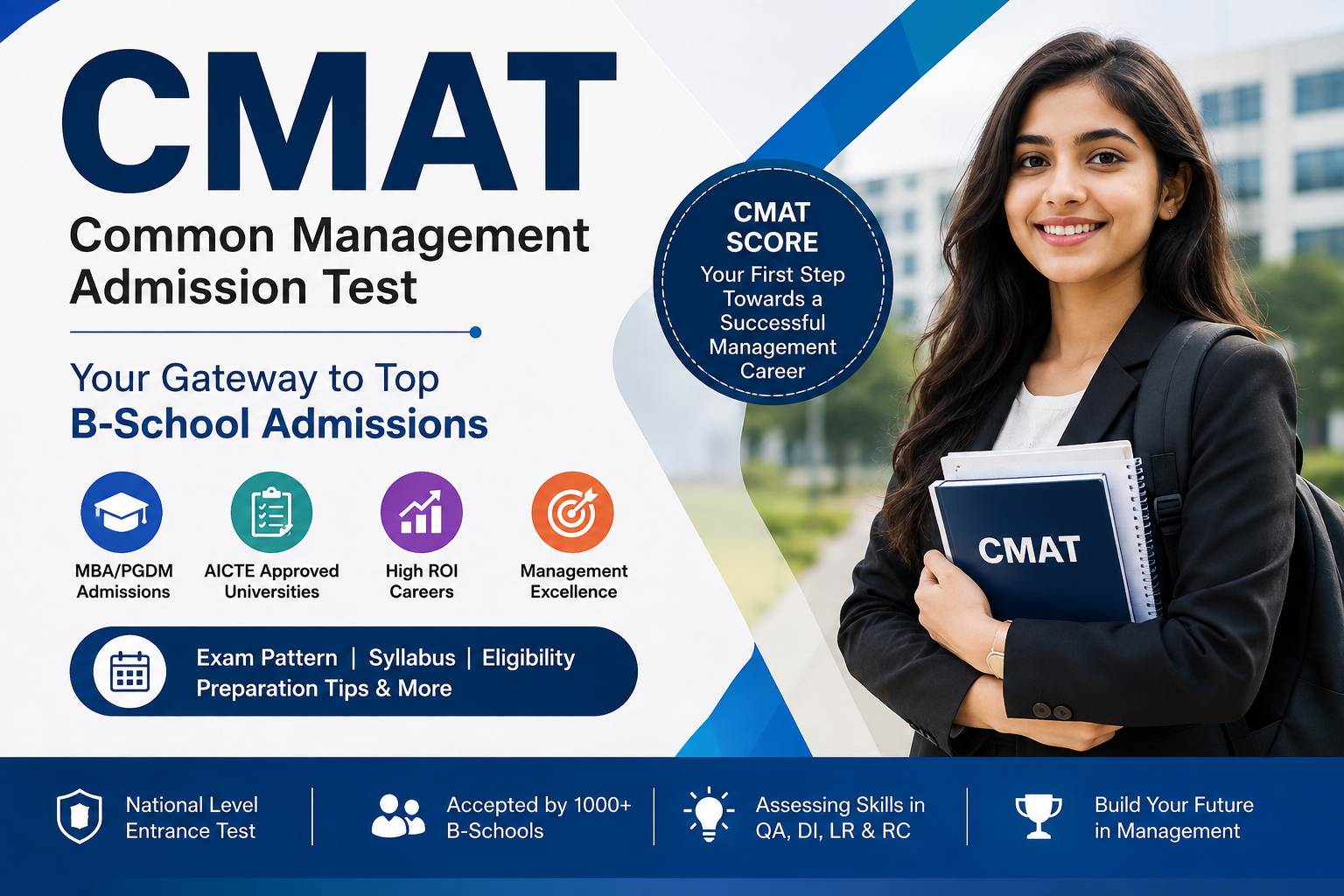
Common Management Admission Test (CMAT)

The Common Management Admission Test (CMAT) is a national-level entrance examination conducted for admission to MBA, PGDM, Executive PGDM, and other management programs offered by AICTE-approved institutions and several universities across India. The exam evaluates candidates’ aptitude in quantitative techniques, logical reasoning, language comprehension, general awareness, and innovation & entrepreneurship.

CMAT Highlights:

  • Exam Name: Common Management Admission Test (CMAT)
  • Exam Level: National
  • Exam Mode: Computer-Based Test (CBT)
  • Conducting Body: National Testing Agency (NTA)
  • Course Offered: MBA, PGDM and Management Programs
  • Duration: 3 Hours
  • Question Type: Multiple Choice Questions (MCQs)
  • Language: English
  • Frequency: Once every year

Why Choose CMAT?

  • Accepted by 1,000+ MBA colleges.
  • Easier compared to several other MBA entrance exams.
  • Low application fee.
  • No sectional time limit.
  • Good opportunity for admission into reputed B-Schools.
  • Suitable for fresh graduates and working professionals.

CMAT Eligibility Criteria:

Candidates must satisfy the following requirements:

  • Must hold a Bachelor’s Degree in any discipline.
  • Final-year undergraduate students are also eligible.
  • No minimum age limit.
  • No upper age limit.
  • Indian nationals can apply.
  • Percentage requirements depend on the participating institute.

CMAT Exam Pattern

Section                                                                                                                 Questions
Quantitative Techniques & Data Interpretation                                                   20
Logical Reasoning                                                                                                        20
Language Comprehension                                                                                        20
General Awareness                                                                                                       20
Innovation & Entrepreneurship                                                                                 20
Total Questions                                                                                                       100

Marking Scheme:

  • Correct Answer: +4 Marks
  • Incorrect Answer: -1 Mark
  • Unanswered Questions: No Negative Marking
  • Maximum Marks: 400

CMAT Syllabus

1. Quantitative Techniques & Data Interpretation

Topics include:

  • Arithmetic
  • Algebra
  • Geometry
  • Mensuration
  • Number System
  • Probability
  • Permutation & Combination
  • Time & Work
  • Profit & Loss
  • Percentages
  • Ratio & Proportion
  • Data Interpretation
  • Pie Charts
  • Tables
  • Graphs

2. Logical Reasoning

Important topics:

  • Blood Relations
  • Coding-Decoding
  • Seating Arrangement
  • Syllogism
  • Statement & Assumptions
  • Cause & Effect
  • Direction Sense
  • Critical Reasoning
  • Analogies
  • Puzzles

3. Language Comprehension

Major topics:

  • Reading Comprehension
  • Vocabulary
  • Grammar
  • Sentence Correction
  • Para Jumbles
  • Synonyms
  • Antonyms
  • Fill in the Blanks
  • Idioms and Phrases

4. General Awareness

Includes questions on:

  • Current Affairs
  • Indian Economy
  • History
  • Geography
  • Politics
  • Business News
  • Sports
  • Awards
  • Science
  • International Affairs

5. Innovation & Entrepreneurship

Topics include:

  • Startup Ecosystem
  • Government Initiatives
  • Business Models
  • Intellectual Property Rights
  • Entrepreneurship Concepts
  • Business Environment
  • Marketing Basics
  • Financial Awareness

CMAT Preparation Tips

Create a Study Plan

  • Allocate daily time for each section.

Practice Mock Tests

  • Attempt full-length mock tests regularly.

Improve Speed

  • Practice solving questions within time limits.

Read Newspapers

  • Stay updated with current affairs and business news.

Solve Previous Year Papers

  • Understand question patterns and difficulty level.

Revise Regularly

  • Prepare short notes and revise them weekly.

Best Books for CMAT Preparation

Quantitative Aptitude

  • Quantitative Aptitude by R.S. Aggarwal
  • How to Prepare for Quantitative Aptitude by Arun Sharma

Logical Reasoning

  • A Modern Approach to Logical Reasoning by R.S. Aggarwal

Verbal Ability

  • Word Power Made Easy by Norman Lewis
  • High School English Grammar by Wren & Martin

General Awareness

  • Manorama Yearbook
  • Monthly Current Affairs Magazines

CMAT Selection Process

  • CMAT Examination
  • Score Card
  • College Application
  • Shortlisting
  • Group Discussion (GD)*
  • Personal Interview (PI)
  • Final Merit List
  • Admission

Documents Required:

  • CMAT Admit Card
  • CMAT Score Card
  • Graduation Mark Sheets
  • Degree Certificate
  • Class 10 & 12 Certificates
  • Government Photo ID
  • Passport-size Photographs
  • Category Certificate (if applicable)

Career Opportunities After MBA Through CMAT

Graduates can pursue careers such as:

  • Marketing Manager
  • Financial Analyst
  • HR Manager
  • Business Consultant
  • Operations Manager
  • Project Manager
  • Sales Manager
  • Product Manager
  • Data Analyst
  • Entrepreneur

Frequently Asked Questions (FAQs)

Is CMAT easier than CAT?

  • Generally, CMAT is considered moderately difficult and is often viewed as less challenging than CAT.

How many times is CMAT conducted in a year?

  • CMAT is usually conducted once every year.

Is there negative marking?

  • Yes. One mark is deducted for every incorrect answer.

Can final-year students apply?

  • Yes. Final-year bachelor’s degree students are eligible.

Is CMAT accepted by all MBA colleges?

  • No. CMAT is accepted by many AICTE-approved institutions and participating universities, but not all MBA colleges.

CMAT is an excellent opportunity for graduates seeking admission to quality MBA and PGDM programs across India. With a well-planned preparation strategy, consistent practice, and strong conceptual understanding, candidates can achieve a competitive score and secure admission to leading management institutes. Begin your preparation early, practice mock tests regularly, stay updated with current affairs, and focus on time management to maximize your chances of success.

MBA Degree in One Year

Looking for an MBA Degree in One Year? Fast-track programs are designed for eligible working professionals and candidates seeking career advancement. Enhance your management, leadership, and business skills while balancing your professional commitments. Check eligibility, university guidelines, and admission requirements to find the right program for your career goals.